I am a native in this world And think in it as a native thinks

Showing posts with label comets. Show all posts

Tuesday, September 12, 2023

Astronomy Tuesday


Comet Nishimura was only discovered last month but it's already developed quite an impressive tail from its interactions with the solar wind.

Credit and Copyright: Peter Kennett

Tuesday, March 28, 2023

Astronomy Tuesday


Comet C/2022E3 (ZTF), which was lighting up the northern skies last month, is now on its way out of the neighborhood, possibly never to return.

Image Credit and Copyright: Rolando Ligustri

Tuesday, January 18, 2022

Astronomy Tuesday


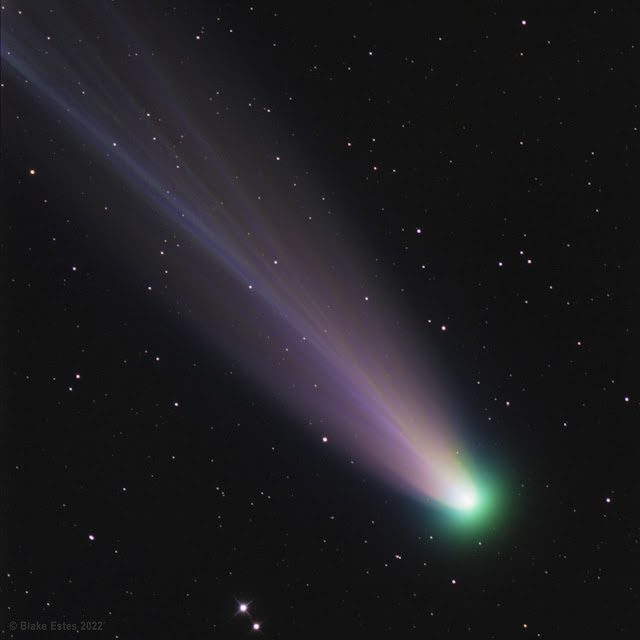
Here's a last look at Comet Leonard, which has completed its swing around our sun and is now headed out of the solar system. You can really see the colors in this image, the green coma surrounding the head of the comet, and the blues in the tail.

Researchers at the University of New South Wales found that the green color that surrounds the heads of some comets is caused by the reaction between diatomic carbon—a highly reactive form of carbon found in stars and comets—in the comet's coma and the ultraviolet radiation from the sun. The blue color in the tail comes from carbon monoxide.

Image Credit and Copyright: Blake Estes (itelescope.net)

Tuesday, January 4, 2022

Astronomy Tuesday


The spectacular Comet Leonard is unfortunately not really visible from my part of the planet, but at least I can look at the pictures.

Image Credit and Copyright: Rolando Ligustri (CARA Project, CAST) and Lukas Demetz

Tuesday, December 21, 2021

Astronomy Tuesday


I don't usually look for videos for astronomy topics, as the still images are bountiful and amazing.

But a couldn't resist this one: a view of Comet Leonard from the European Space Agency's Solar Orbiter. That's Mercury and Venus passing by in the top right of the video.

Tuesday, September 21, 2021

Astronomy Tuesday


It's baaaack!

When we last saw comet C67/P Churyumov-Gerasimenko several years ago, the Rosetta probe had landed on it and managed to send back several images before self-destructing.

Its 6.4 year orbit takes it out beyond the orbit of Jupiter but it's approaching the sun again and will be visible through a telescope over the next few months.

Image Credit and Copyright: Rolando Ligustri (CARA Project, CAST)

Tuesday, July 21, 2020

Astronomy Tuesday


A beautiful look at Comet Neowise, which is gracing our evening skies at the moment.

I'm not going to get to see it, unfortunately. It's been beastly hot, and while there might be an unobstructed sightline over the Hudson, that feels like a very long way to walk with a mask in this weather. And the light pollution would still make it hard to see. But I am enjoying all the pictures!

Image Credit and Copyright: Miloslav Druckmuller (Brno University of Technology)

Tuesday, May 5, 2020

Astronomy Tuesday


My what a big tail you have!

Newly discovered comet SWAN has just  passed inside the Earth's orbit, and will be closest to us on May 13 before moving on to approach the sun. It may be bright enough to see with the naked eye in June -- or it may not; comets are notoriously unpredictable.

Image Credit and Copyright: Gerald Rhemann

Tuesday, March 24, 2020

Astronomy Tuesday


That's comet ATLAS C, glowing an eerie green in the upper left corner of this image. It was discovered by the Asteroid Terrestrial-impact Last Alert System in late 2019, and will reach its closest approach to the sun on May 31.

In the lower right corner are two galaxies, M81 and M82, who have been engaged in gravitational warfare for the last billion years or so -- each pass takes them a hundred million years, so the battle is as slow-motion as you can get.

I especially love the colors in this image -- all those stars and galaxies and nebulae in red and blue and yellow and white, like a celestial Christmas tree. It's a beautiful spring morning in New York and I'd love to go look for birds, but the Governor has not-so-politely told us to stay out of the parks so I'll be a good citizen and stay in my neighborhood. At least I can hear them singing.

Image Credit and Copyright: Rolando Ligustri (CARA Project, CAST)

Tuesday, October 9, 2018

Astronomy Tuesday


Another gray day, another splash of color.

Comet 21P / Giacobini-Zinner sends some of its nucleus across Earth's skies every six and a half years in the form of the Draconid meteor showers. The comet is pictured on its approach two weeks ago, between the Rosette (upper left) and Cone (lower right) nebulae.

Image Credit and Copyright: Fritz Helmut Hemmerich

Tuesday, November 7, 2017

Astronomy Tuesday


Well, this is very cool.

I posted an image from the surface of comet C67/P Churyumov-Gerasimenko several years ago, commenting that the Rosetta probe wasn't getting a sufficient charge on its solar panels and there might not be any more pictures. But Rosetta, like the Mars Rover, just kept going, and sent this picture last July, shortly before self-destructing. This plume of dust and water-ice emerging from beneath the comet's surface may show how a comet gets its tail.

Image Credit & Copyright: ESA, Rosetta, MPS, OSIRIS; UPD/LAM/IAA/SSO/INTA/UPM/DASP/IDA

Tuesday, March 29, 2016

Astronomy Tuesday


That bright green dot in the lower right-hand quadrant of this image is a comet with the not exactly mellifluous name of 252P/Linear.

This photo was taken in Australia, shortly before the comet's closest approach to Earth (you can see the Southern Cross over on the right, four stars in the shape of a small kite partially overlapping the Milky Way.) It's visible in the Northern Hemisphere now, but if you miss it it will be back in 2032.

Image Credit and Copyright: Alex Cherney (Terrastro, TWAN)

Tuesday, August 25, 2015

Astronomy Tuesday


Here's a new comet for your viewing pleasure. And a swallowtail comet to boot!

Comet Catalina was discovered in 2013, and is currently only visible in the Southern Hemisphere, and then only with binoculars. But as it moves closer the the sun, it could become visible to the naked eye. Or not. You never know with comets.

It will move into the Northern Hemisphere in December. Where it may or may not be visible -- see above.

Image Credit and Copyright: Ian Sharp

Tuesday, June 9, 2015

Astronomy Tuesday

That green glow in the center left of this picture is Comet Lovejoy -- or rather, the latest Comet Lovejoy, as Terry Lovejoy has discovered four previous bearers of the name. (You know you've been watching too much Game of Thrones when you want to introduce an astronomical object as “Comet Lovejoy, the fifth of its name.”)

The bright star on the right is Polaris, the North Star. It's not especially bright seen from Earth, but because it's close to the celestial pole, the place in the sky where our planet's axis points, it's the pivot around which the northern skies appear to revolve. So some of us may think the universe revolves around us, but Polaris can actually make a very strong case for it.

Image Credit & Copyright: Rogelio Bernal Andreo

Tuesday, March 3, 2015

Astronomy Tuesday


Here's another look at Comet Lovejoy, still in the neighborhood and displaying an impressive, if crooked, tail.

Image Credit and Copyright: Rolando Ligustri (CARA Project, CAST)

Tuesday, December 30, 2014

Astronomy Tuesday


The Star of Bethlehem may not actually have been a comet, but here's one in Christmas colors -- Comet Lovejoy, discovered in August, set for its pass by Earth on January 7th.

Image Credit and Copyright: Damian Peach/SEN

Tuesday, November 18, 2014

Astronomy Tuesday


So this is what a comet looks like.

Philae, the lander for the Rosetta mission, landed safely on the surface of C67/P Churyumov-Gerasimenko, but sadly not in a position where its solar panels received enough light to keep it going. So this sort of selfie -- the lander's foot is in the bottom left corner -- may be the best photo we get.

Image Credit: ESA/Rosetta/Philae/CIVA

Blog Archive