I am a native in this world And think in it as a native thinks

Showing posts with label Saturn. Show all posts

Tuesday, December 9, 2025

Astronomy Tuesday


This amazing image was one of the winners in the ZWO Astronomy Photographer of the Year for 2025. It was taken during the lunar occultation (when the moon passes in front of another celestial object) of Saturn in August.

Image credit: “Saturnrise” © Tom Williams (UK)
Tuesday, March 14, 2023

Astronomy Tuesday


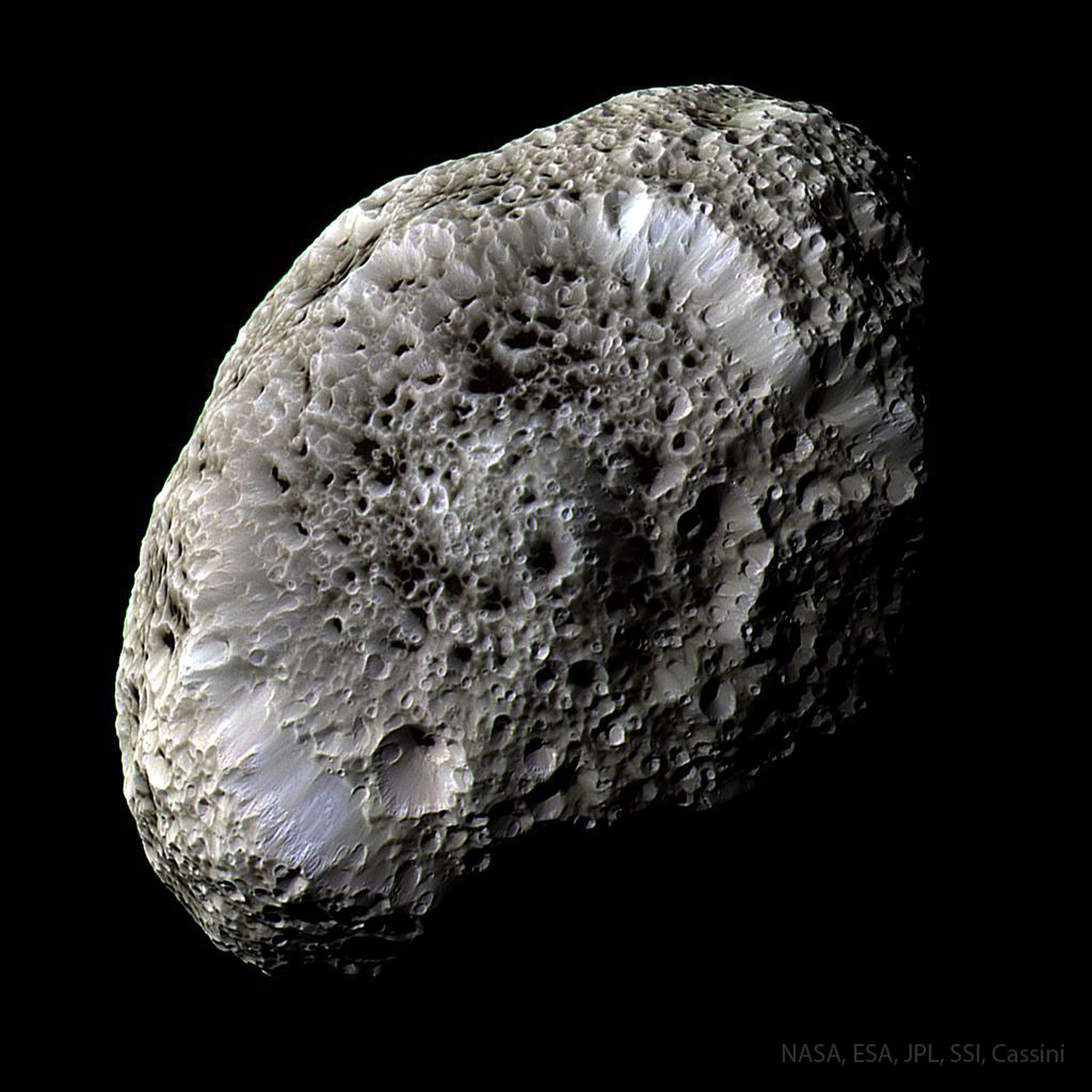
I know I posed a Cassini image of Saturn just a few weeks ago, but I can't resist this one: Saturn's moon Hyperion. This small (approximately 250 kilometers across—small for a moon) strange object looks to me like something I might pick up on the beach, and so I suppose in a way, it's not strange at all. Unlike so much of what we're able to see in the universe now, it looks almost familiar.

Image Credit: NASA, ESA, JPL, SSI, Cassini Imaging Team

Tuesday, February 28, 2023

Astronomy Tuesday


The Cassini probe may be gone, but fortunately we still have all of its amazing images of Saturn. This is from 2006.

Image Credit: NASA/JPL/Space Science Institute;

Tuesday, February 7, 2023

Astronomy Tuesday


This image of Saturn's icy moon Enceladus taken by the late great Cassini probe is interesting because of the light. That crescent of brightness on the right is from the sun, but if you look at the shadows you can see that there's another, less intense, light source on the left. That light is coming from Saturn itself, reflecting sunlight back onto its moon like a giant mirror.

Image Credit: NASA; ESA, JPL, Cassini Imaging Team, SSI; Color Composite: Gordan Ugarkovic

Tuesday, September 27, 2022

Astronomy Tuesday


Twitter user the moon's wife (@bookishseawife) posted this last week: 
the appalachian mountains are older than saturn’s rings. the appalachian mountains are older than dinosaurs. the appalachian mountains are older than trees. the appalachian mountains are literally older than BONES. the appalachian mountains should be regarded with pure terror.

I am so accustomed to thinking of the universe as unimaginably large and unimaginably old that I sometimes lose sight of the how old and weird our Earth is.

And though when I first read this I thought, “Well, that can't be right,” the Appalachians (which are about 480 million years old) are in fact older than the rings of Saturn. The rings were long thought to be the same age as the planets (about 4.5 billion years old), but the data collected by Cassini showed that they are actually only about 100 million years old.

Image credit: NASA/JPL-Caltech/Space Science Institute

Tuesday, June 14, 2022

Astronomy Tuesday


That's Saturn of course, in the foreground, in another wonderful image taken by the Cassini probe in 2014.

But if you look closely at the background, you'll see a tiny blue dot in the upper left corner. That's Uranus, which was approximately 28.6 astronomical units away from Cassini and Saturn when this picture was taken. One astronomical unit is the distance from the Earth to the Sun, or 93,000,000 miles, so if I'm doing the calculation correctly, Uranus was billions of miles away and it's miraculous that we can see it here at all.

The only thing that amazes me as much as this universe is the human ingenuity that allows us to see so much of it.

Image credit: NASA/JPL-Caltech/Space Science Institute

Tuesday, January 25, 2022

Astronomy Tuesday


It's always wonderful to see a new image from the late, great Cassini probe. Tethys, the moon in this picture, is one of five major moons that orbit Saturn outside the major rings, but within the faint E ring.

Tethys may be a (comparatively) small lump of ice, but the views must be amazing.

Image Credit: Cassini Imaging Team, SSI, JPL, ESA, NASA

Tuesday, September 14, 2021

Astronomy Tuesday


Nighttime on Saturn, as seen by Cassini two days before its long mission ended in 2017.

Image Credit: NASA, JPL-Caltech, Space Science Institute, Mindaugas Macijauskas

Tuesday, August 11, 2020

Astronomy Tuesday


A new image from Cassini -- well, new to me -- is just what I needed this morning. This shows Saturn in crescent, something that we'd never be able to see from Earth, with the shadows from the rings on the planet's surface, and the shadow of the planet across the rings.

Image Credit: NASA, ESA, SSI, Cassini Imaging Team

Tuesday, June 2, 2020

Astronomy Tuesday


Here's some welcome perspective on this blissfully quiet morning -- even the robins have shut up for a change.

The bright dot seen peeking through Saturn's rings is our own wounded planet, and the faint tiny dot just above it is our moon.

I take comfort in knowing that if you could step back a few hundred million miles, all you would see of us is that tiny beacon.

The light is there, even if we can't always see it.

Image Credit: NASA, ESA, JPL-Caltech, SSI, Cassini Imaging Team; Processing and License: Kevin M. Gill

Tuesday, April 7, 2020

Astronomy Tuesday


How endlessly beautiful is Saturn?

And how much do I need that beauty these days? This minimalist Cassini image from 2015 shows the moon Dione against the bright line of the rings (and you can just see that scamp Enceladus photobombing in the upper right corner.)

NASA/JPL-Caltech/Space Science Institute

Tuesday, October 22, 2019

Astronomy Tuesday


Ordinarily I wouldn't post another Saturn image but I couldn't possibly resist this one from Cassini: an array of moons.

Image Credit: Cassini Imaging Team, SSI, JPL, NASA

Tuesday, September 24, 2019

Astronomy Tuesday


Nothing makes me happier than finding a new Cassini image of Saturn.

This picture shows a view we can never get from Earth: the planet backlit by the Sun. It was taken two days before Cassini's final death plunge into the planet's atmosphere in 2017.

Image Credit: NASA, JPL-Caltech, Space Science Institute, Mindaugas Macijauskas

Tuesday, September 3, 2019

Astronomy Tuesday


The moon, of course, but if you look in the upper right background you can see a tiny, perfect image of Saturn.

I'm drowning in pictures of Newfoundland. I may post some tomorrow.

Image Credit: Peter Patonai (Astroscape Photography)

Tuesday, May 7, 2019

Astronomy Tuesday


The Cassini probe may be gone, but its legacy of wonderful images from Saturn goes on.

Here the rings are almost edge on, in front of a backlit Titan. And the little moon just below Titan is Enceladus.

Image Credit: NASA, ESA, JPL, SSI, Cassini Imaging Team

Tuesday, March 12, 2019

Astronomy Tuesday


A gorgeous image of Saturn's moon Enceledus, taken in November 2016 by the late great Cassini probe.

Image Credit: Cassini Imaging Team, SSI, JPL, ESA, NASA

Tuesday, October 16, 2018

Astronomy Tuesday


I've checked, and I don't think I ever posted this image from Cassini from 2012. And if I did, it was a long time ago, and it's certainly worth looking at again. This is what the rings look like from underneath, when the sun is shining on the other side. That's Tethys in the top left corner.

Image Credit: Cassini Imaging Team, SSI, JPL, ESA, NASA

Tuesday, August 14, 2018

Astronomy Tuesday


The Cassini probe took this picture in 2007, but NASA just posted it yesterday.

NASA/JPL-Caltech/Space Science Institute

Tuesday, June 5, 2018

Astronomy Tuesday


This large, shiny walnut is Iapetus, one of Saturn's more than 60 moons. Though it is the third-largest, and was discovered in 1671 by Giovanni Cassini himself, I have to admit having been unaware of its existence until yesterday when I found this picture.

Credit: Cassini Imaging Team, SSI, JPL, ESA, NASA

Tuesday, April 3, 2018

Astronomy Tuesday


Cassini, of course. The probe may have plunged into the cloudy unknown of Saturn's surface last year, but its magnificent images still amaze me.

This one, from 2005, shows two of the smaller moons, Tethys and Mimas, but what's really cool here is the shadow of the rings  across the top of the planet. (The rings themselves are seen edge-on between the two moons.)

Blog Archive