I am a native in this world And think in it as a native thinks
Showing posts with label star cluster. Show all posts
Tuesday, January 10, 2023
Astronomy Tuesday
I always love images of the Pleiades, but this one really shows off the blue reflection nebula surrounding the star cluster.
Image Credit and Copyright: Stefan Thrun
Tuesday, November 22, 2022
Astronomy Tuesday
Now that's a starry night! This double star cluster in Perseus was first recorded in 130 B.C. by the Greek astronomer Hipparchus.
Hipparchus spent his last years on Rhodes, which is the only Greek island I've actually visited, and the pleasant memories of that trip make me inclined to forgive him for having invented trigonometry.
Image Credit and Copyright: Tommy Lease
Tuesday, September 28, 2021
Astronomy Tuesday
In Astronomy as in Real Estate, it's location, location, location.
In this image, the location that matters is our vantage point here on Earth, which puts these two very different objects into the same frame. M52, the star cluster on the left, is a mere 5000 light years away, while the Bubble Nebula, on the right, is more than twice as far. But seen from Earth, they look like neighbors.
Image Credit and Copyright: Lorand Fenyes
Tuesday, May 11, 2021
Astronomy Tuesday
These are two of the many star clusters that hang out around our Milky Way, M35 (on the lower left) and NGC 2158 (upper right).
As you can tell from all the bright blue stars, M35 is much younger; blue stars like these are always young, at least in galactic terms, because they just don't last very long. The hot blue giants that may have once existed in NGC 2158 have long since died, leaving only the older, smaller yellow stars.
Image Credit and Copyright: CFHT, Coelum, MegaCam, J.-C. Cuillandre (CFHT) and G. A. Anselmi (Coelum)
Tuesday, March 9, 2021
Astronomy Tuesday
This gorgeous widefield view is a closeup of the constellation Taurus -- the bright orangey star in the lower left is Aldeberan, the brightest star, and the literal bull's eye, in the constellation. Like many of the brightest stars, Aldeberan was named by Arabic astronomers; the name means “the follower,” because it was always following the Pleiades through the sky.
But what is that other, even brighter, star just below the Pleiades in the bottom center? That's not a star; that's our neighbor Mars, dropping in for a photobomb. In this picture it could pass for Aldeberan's younger sibling, but like so many pairings in our night sky, the two of them are billions of miles apart and only appear close in our limited line of sight from Earth.
The red glow at the top of the image is the California nebula.
Image Credit and Copyright: Petr Horalek / Institute of Physics in Opava
Tuesday, October 27, 2020
Astronomy Tuesday
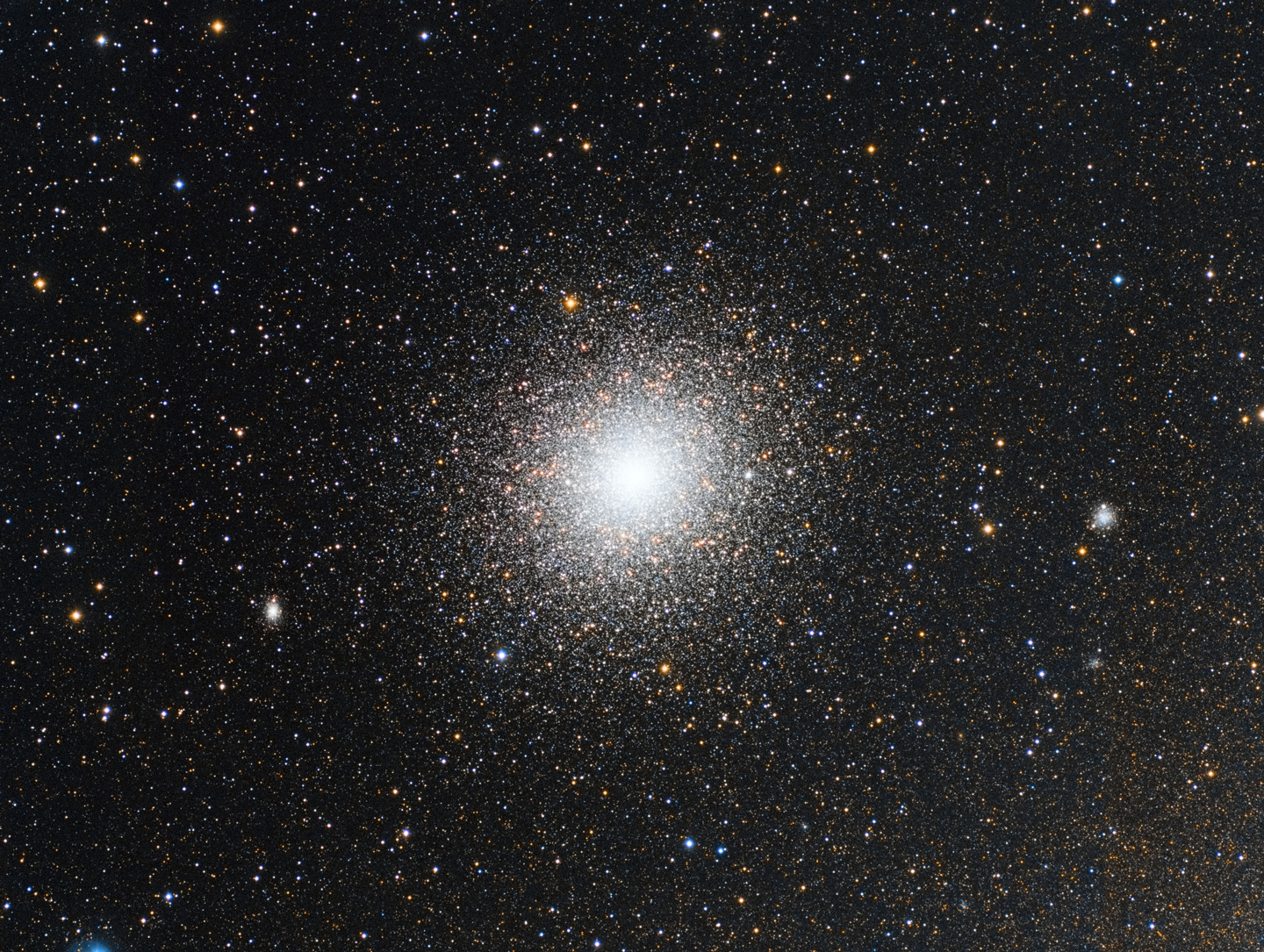
This beautiful star cluster, 47 Tucanae, can be seen with the naked eye near the Small Magellanic Cloud, unfortunately only in the Southern Hemisphere.
Maybe someday.
Image Credit and Copyright: Jose Mtanous
Maybe someday.
Image Credit and Copyright: Jose Mtanous
Tuesday, December 17, 2019
Tuesday, October 15, 2019
Astronomy Tuesday
This beautiful star cluster, captured by Hubble, has the very unromantic name of NGC 290. An open cluster like this one, as opposed to a globular cluster, tends to be younger and so has many more bright blue stars. Since all of the stars in an open cluster were born at around the same time, astronomers find them useful for studying how stars of differing masses evolve differently.
Image Credit: NASA, ESA, Hubble; Acknowledgement: E. Olzewski (U. Arizona)
Tuesday, May 28, 2019
Astronomy Tuesday
This image was released to celebrate the 25th anniversary of the Hubbell Space Telescope in 2015.
The star cluster Westerland 2 in the Milky Way contains some of the hottest and brightest stars we can observe and you can see how the stellar winds from those massive stars are blowing the nebula gases away.
NASA, ESA, the Hubble Heritage Team (STScI/AURA), A. Nota (ESA/STScI), and the Westerlund 2 Science Team
Tuesday, March 19, 2019
Tuesday, October 23, 2018
Wednesday, November 15, 2017
Astronomy Wednesday
Apologies for being a day late -- getting through those two days at the office was a little more challenging than expected, and I had no time for blogging.
I'm at Newark airport, waiting for my flight to Brussels, so finally have a chance to catch my breath. The United lounge is closed for renovations and I am sitting in the charmless “pop-up” temporary lounge. It isn't much more comfortable than sitting at the gate -- it doesn't even have a bathroom -- but there are free snacks and wi-fi, so at least I can post this lovely image: NGC 7789, also known as Caroline's Rose, after its discoverer, Caroline Herschel. She's a fascinating character in the history of astronomy; her brother was William Herschel, best known for discovering Uranus. While she spent most of her time assisting him, she also discovered eight comets on her own, and was one of the first women granted honorary membership in the Royal Society.
Image Credit and Copyright: Guillaume Seigneuret
I'm at Newark airport, waiting for my flight to Brussels, so finally have a chance to catch my breath. The United lounge is closed for renovations and I am sitting in the charmless “pop-up” temporary lounge. It isn't much more comfortable than sitting at the gate -- it doesn't even have a bathroom -- but there are free snacks and wi-fi, so at least I can post this lovely image: NGC 7789, also known as Caroline's Rose, after its discoverer, Caroline Herschel. She's a fascinating character in the history of astronomy; her brother was William Herschel, best known for discovering Uranus. While she spent most of her time assisting him, she also discovered eight comets on her own, and was one of the first women granted honorary membership in the Royal Society.
Image Credit and Copyright: Guillaume Seigneuret
Subscribe to:
Posts (Atom)