It snowed all Saturday night and most of yesterday morning, and I played hooky from studying long enough to make a quick trip to the park. It was magical.
I am a native in this world And think in it as a native thinks
Monday, February 14, 2022
Bird blogging, Valentine's Day edition
Here are a pair of Northern Shovelers and one of Hooded Mergansers from the Central Park reservoir for your Valentine's Day viewing pleasure.
In other bird romance news, the talk of the reservoir has been the unlikely pairing of the male wood duck whose picture I posted a few weeks ago with a female mallard. Are they just friends? Or will we see a new duck hybrid species later this spring? Inquiring minds (and bored birders waiting for the bald eagle to show up) want to know!
Labels:
bird blogging,
birds,
Central Park,
New York,
reservoir,
water
Sunday, February 13, 2022
Sunday bird blogging
Here's a potential mate for the male hooded merganser I posted last week: a pretty female, swimming in the Central Park reservoir.
Labels:
bird blogging,
birds,
Central Park,
New York,
reservoir,
water
Saturday, February 12, 2022
Friday, February 11, 2022
Friday architecture
The new entrance to Penn Station—not the Moynihan annex in the old post office building, but the underground station for commuter trains—on Seventh Avenue.
Labels:
architecture,
black and white,
New York,
railway stations
Thursday, February 10, 2022
Wednesday, February 9, 2022
Astronomy Tuesday
(Okay, I know it's Wednesday, but I spent two days creating a quiz for my new students and got all mixed up. I honestly thought it was still Monday all day yesterday.)
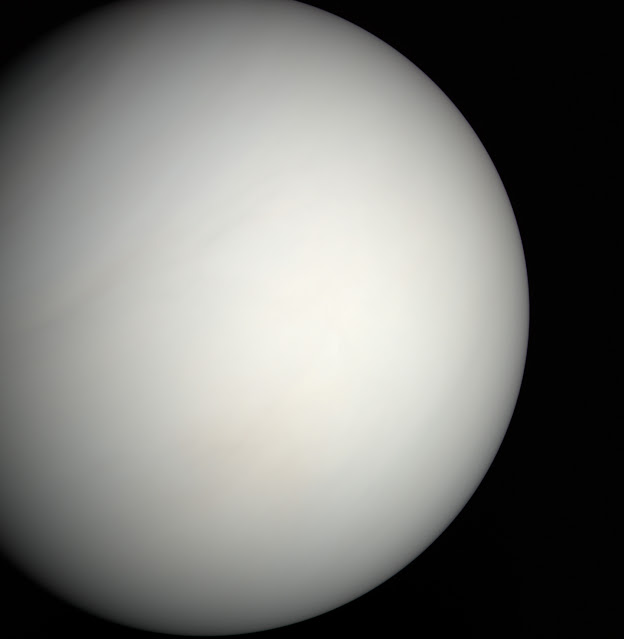
After posting the radio wave image of the galaxy center last week, I thought this was an interesting followup. This featureless gray-white billiard ball is Venus, as photographed by the Messenger mission in 2007. This is very different from the golden brown images we usually see, but in fact this is what Venus would look like to humans who flew near the planet.
This article is an interesting explanation of why the colors we see in astronomical images aren't usually true color, human eye-perceiving, visual spectrum representations. Sometimes they've just enhanced the colors, like any amateur photographer with a copy of Photoshop does routinely (Is Neptune really blue? Yes, but not that blue) but sometimes it's because the most interesting look at a celestial object is in a spectrum like ultraviolet, or radio waves, that we can't see, so it has to be translated before we can look at it.
Image credit: NASA / JHUAPL / CIW / G. Ugarkovic
Sunday, February 6, 2022
Sunday bird blogging
I took a break from homework this afternoon and went up to the reservoir in Central Park to see if I could catch a glimpse of the new avian celebrity in town, a bald eagle that for some reason has been dubbed “Rover”, and who has been spending time by the reservoir.
Rover was not in residence, but I did see some lovely hooded mergansers. This handsome fellow's hood is wet from diving for his lunch, so doesn't stand up as much as they usually do.
Labels:
bird blogging,
birds,
Central Park,
New York,
water
Saturday, February 5, 2022
Tuesday, February 1, 2022
Astronomy Tuesday
I have posted many gorgeous images through the years, but this one may be my favorite; it looks like an abstract painting I would love to hang on my wall. It's one of a series of images taken by the MeerKAT telescope at the South African Radio Astronomy Observatory (SARAO) and shows the center of our Milky Way galaxy, including the giant black hole at the core, in radio emissions.
Radio emissions are just another kind of electomagnetic radiation (EMR), like the visible spectrum, and light like infrared or ultraviolet that our eyes can't see. A lot of astronomical images use the non-visible types of EMR to show us different views of galaxies and nebulae and other objects, but I haven't seen that many radio images. Some of the MeerKAT pictures have been “translated” into color, and look more like the usual images I post, but this one is in grayscale, with color only for the strongest emissions. And it's beautiful.
Credit: I. Heywood, SARAO
Labels:
astronomy,
black holes,
galaxies,
Milky Way,
radio astronomy
Subscribe to:
Posts (Atom)